
Chicken pad thai tastes right when the sauce is built on the tamarind-fish sauce-palm sugar trinity in a 3:2:2 ratio (by volume). That’s it. Three parts tamarind concentrate, two parts fish sauce, two parts palm sugar dissolved in warm water. Cold-soak the rice noodles 30 minutes (not boiled) so they’re pliable but not yet cooked. Stir-fry chicken, scramble eggs in the wok, add noodles, pour the sauce, toss quickly. Peanuts, lime, and chili flakes finish. 25 minutes.
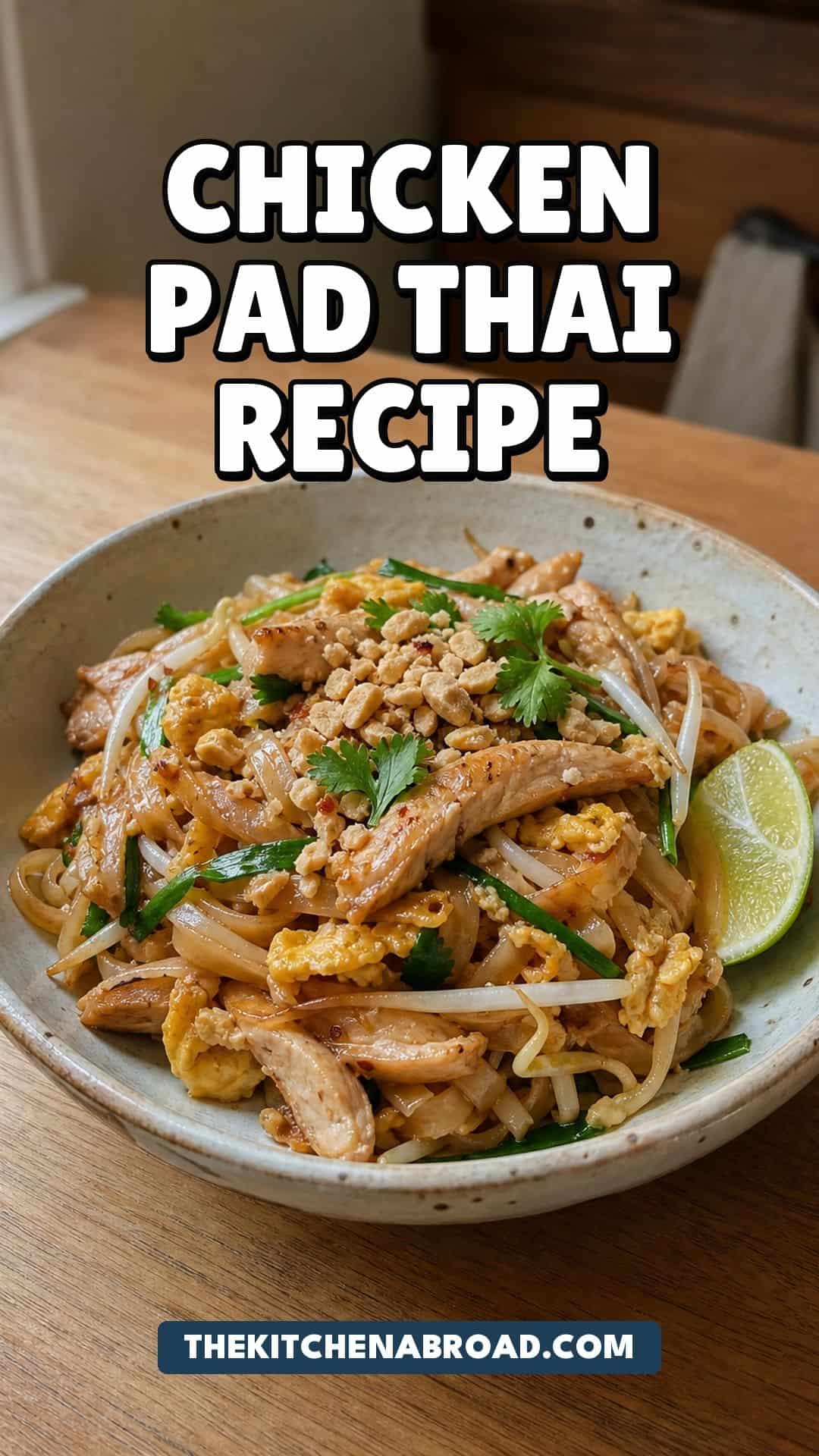
Most Americanized pad thai uses ketchup or peanut butter where the sauce should be tamarind. Both are flat substitutes that produce something sweet and reddish but unrelated to actual pad thai. The dish lives or dies on the tamarind, which gives the sour backbone the rest of the sauce balances against.
The other foundational move is the noodle. Rice noodles cold-soaked in tap water for 30 minutes come out pliable but still firm, which means they finish cooking in the wok with the sauce, absorbing flavor as they go. Pre-boiled noodles arrive already-tender and turn mushy in the toss. Cold-soak is the technique difference.
What’s on the Counter for Pad Thai
A carbon steel wok or large heavy skillet. The wok shape lets you toss noodles without breaking them. Tamarind concentrate (the paste, not the dried block, unless you want to extract it yourself), fish sauce (Red Boat or Three Crabs are the standards), palm sugar (a chunk that you shave or melt into the sauce), sesame oil for finishing, and a spider strainer for lifting cooked noodles cleanly.


Recommended Reads
- Quick and Easy Chicken Stir-Fry
- One-Pan Honey Garlic Shrimp and Broccoli
- Brown Rice Fried Rice
- Sweet Soy Sauce (Kecap Manis)
- Sambal Oelek
How Pad Thai Became Thailand’s National Dish
Pad thai is younger than most people assume. The dish was popularized in the late 1930s by the Thai government as part of a nationalist push under Prime Minister Plaek Phibunsongkhram, who promoted noodle dishes to reduce rice consumption during economic hardship and to standardize a national cuisine identity. The base of stir-fried rice noodles came from older Chinese-Thai migrant traditions; the tamarind-fish sauce-palm sugar sauce profile is distinctly Thai. The version that became globally famous, with the peanut garnish, the lime wedge, the bean sprouts on the side, was codified in the 1960s and exported through Thai immigration to the U.S, and Europe in the 1980s. The recipe below sits in that classical Bangkok street-food lineage.
A Few Notes on the Ingredients
Dried rice noodles: 200 g (about 7 oz) flat rice noodles, 1/4-inch wide. Look for “pad thai noodles” or banh pho. Don’t substitute thin rice vermicelli; they cook too fast and break. Cold-soak 30 minutes in room-temperature water (not boiled).
Chicken thighs: 400 g (about 14 oz) boneless skinless, sliced thin against the grain. Thighs stay juicy through the high-heat stir-fry; breast turns chewy.
Tamarind concentrate (not paste or juice): 3 Tbsp of the dense brown concentrate (not the watery diluted juice from a carton). Available at any Asian grocery store. If you can only find tamarind paste in a block, soak 50 g in 1/2 cup hot water for 15 min, then strain.
Quality fish sauce: 2 Tbsp of Red Boat 40°N or Three Crabs. Cheap fish sauce produces a thin, simplistic dish.
Palm sugar: 2 Tbsp shaved or chopped from a block. Light brown sugar swaps in if you can’t find palm sugar; flavor is slightly less caramel-deep but works. Coconut sugar also subs cleanly.
Eggs: 2 large eggs, beaten lightly. Scrambled into the hot wok before the noodles go in.
Garlic and shallot: 4 cloves garlic minced + 2 shallots thinly sliced (or 1 small red onion).
Bean sprouts and garlic chives: 1 cup fresh bean sprouts, 1/2 cup garlic chives or scallion greens, both tossed in at the very end so they stay crunchy.
Finish: Roasted unsalted peanuts (chopped), lime wedges, Thai chili flakes, fresh cilantro if you like.
Recipe: Easy Chicken Pad Thai
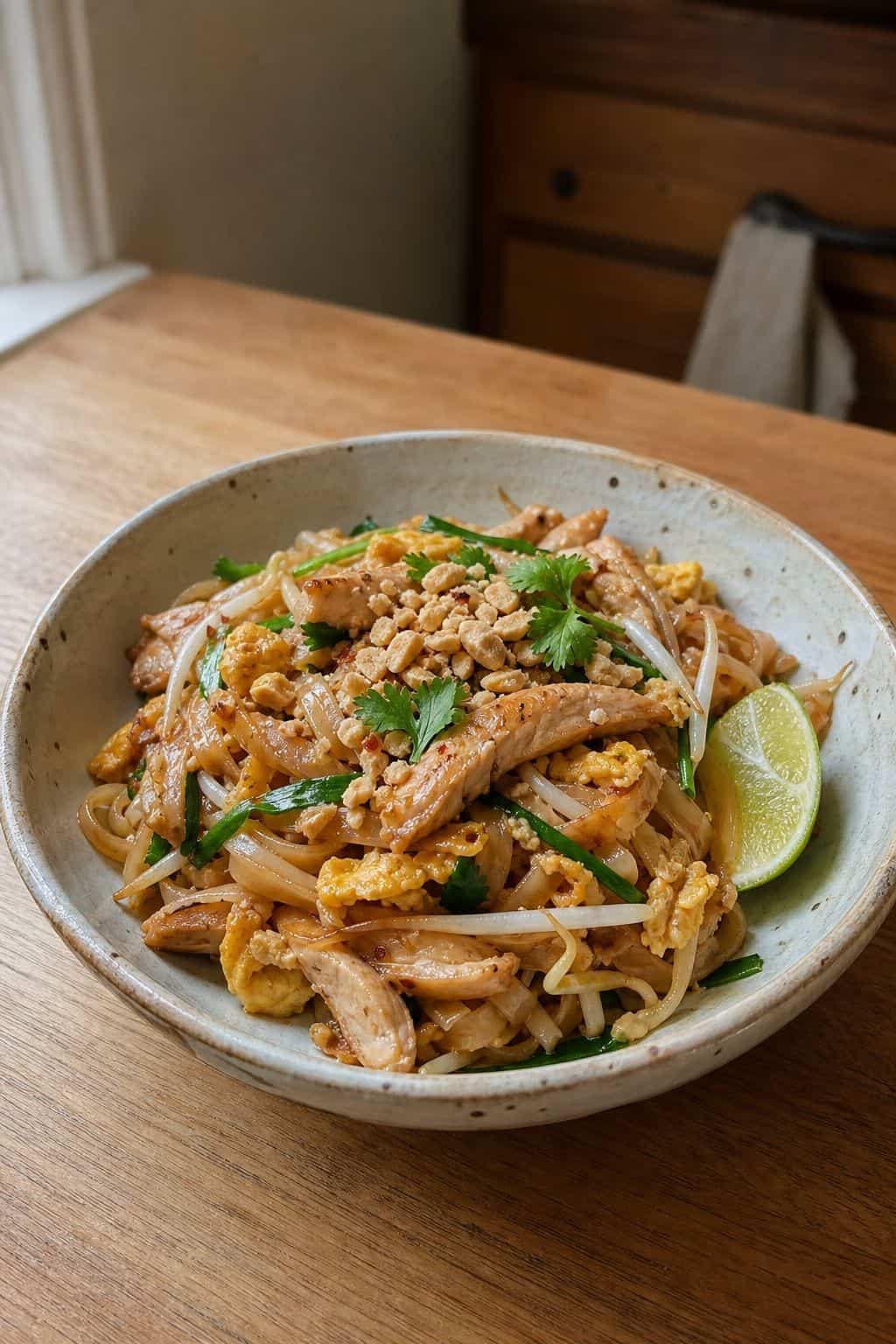
Prep time: 10 minutes | Soak time: 30 minutes | Cook time: 8 minutes | Total time: 48 minutes | Serves: 4
For the Trinity Sauce
- 3 Tbsp tamarind concentrate
- 2 Tbsp fish sauce
- 2 Tbsp palm sugar (or light brown sugar), shaved or finely chopped
- 1 Tbsp warm water
- ½ tsp Thai chili flakes (optional, for heat)
For the Stir-Fry
- 200 g (7 oz) dried flat rice noodles, ¼” wide
- 400 g (14 oz) boneless skinless chicken thighs, sliced thin against the grain
- 2 large eggs, lightly beaten
- 4 cloves garlic, minced
- 2 shallots, thinly sliced (or 1 small red onion)
- 1 cup fresh bean sprouts
- ½ cup garlic chives or scallion greens, cut into 2″ pieces
- 3 Tbsp neutral oil (peanut, vegetable, or avocado)
- ⅓ cup roasted unsalted peanuts, roughly chopped
- 1 lime, cut into wedges
- Extra Thai chili flakes, for serving
- Fresh cilantro, for garnish (optional)
Instructions
- Cold-soak the noodles. Place the dried rice noodles in a large bowl. Cover with room-temperature tap water. Soak 30 minutes. The noodles should be pliable but not yet tender, bend, but don’t break. Drain and set aside.
- Mix the trinity sauce. In a small bowl, combine the tamarind concentrate, fish sauce, palm sugar, warm water, and chili flakes if using. Stir until the palm sugar dissolves. Set near the stove.
- Heat the wok. Place a carbon steel wok or large heavy skillet over high heat. Let it heat 2 minutes until it’s smoking hot. Add 1 Tbsp neutral oil and swirl.
- Cook the chicken. Add the sliced chicken in a single layer. Let sit 60 seconds undisturbed, then toss and cook 1 more minute until just done. Remove to a plate.
- Sauté aromatics. Add 1 more Tbsp oil to the hot wok. Add the shallots and garlic. Cook 30-45 seconds until fragrant but not browned.
- Scramble the eggs. Push the aromatics to the side. Add 1 more Tbsp oil to the cleared spot. Pour in the beaten eggs and let them set 20 seconds before scrambling lightly with a spatula. Don’t fully cook them; the eggs should be just barely set.
- Add noodles and sauce. Add the drained noodles to the wok. Pour the trinity sauce evenly over the noodles. Toss with two spatulas (or spatula + tongs) for 60-90 seconds until the noodles absorb the sauce and turn glossy. They’ll finish cooking here.
- Add the chicken and finish. Return the cooked chicken to the wok. Add the bean sprouts and garlic chives. Toss 30 more seconds, just enough to wilt the chives and warm the sprouts; you want them mostly crunchy.
- Serve. Divide between 4 plates. Top with chopped peanuts, a generous squeeze of lime, extra chili flakes, and fresh cilantro if using. Serve immediately with extra lime wedges on the side.
Notes
Don’t overcrowd the wok. If your wok is small, cook in two batches. Crowded noodles steam instead of stir-fry and turn gummy.
Taste before serving. Pad thai sauce balance is personal; some prefer more lime, some more chili, some more fish sauce. Adjust at the table with the lime wedges, chili flakes, and an extra splash of fish sauce.
If the noodles stick together while soaking: Loosen them with your fingers before draining. They should be separate strands by the time they hit the wok.
Tips and Variations
What Pad Thai Actually Is (and What It Isn’t)
Real pad thai is a sweet-sour-salty stir-fried rice noodle dish built on three pillars: tamarind for the sour, fish sauce for the salty/umami, and palm sugar for the sweet. The 3:2:2 ratio (3 parts tamarind, 2 parts fish sauce, 2 parts palm sugar) is what produces the right balance, not ketchup-sweet, not sriracha-hot, but bright and complex. The peanut, lime, chili flake, and bean sprout garnishes are the texture finish, not the main flavor. American Chinese restaurants often serve a sweet, reddish, ketchup-based version that has nothing in common with this dish beyond the noodle. If your sauce isn’t tamarind-forward, you’re cooking something else.
Why Cold-Soak the Noodles Instead of Boiling
Cold-soaking the rice noodles for 30 minutes in tap water gets them pliable but not yet cooked. They’ll finish cooking in the wok with the sauce, absorbing the tamarind-fish sauce-palm sugar mixture as they go. Boiled noodles arrive at the wok already-tender, and the toss with the sauce overcooks them into mush. The boiled-noodle pad thai is the #1 mistake home cooks make with this dish, and the fix takes literally zero effort: put the noodles in a bowl of room-temperature water, set a 30-minute timer, walk away.
What Protein and Sauce Swaps Actually Work
Shrimp swaps in 1-to-1 for chicken and gives the most traditional version (pad thai with shrimp is the original). Pork tenderloin sliced thin works the same way. For the sauce: tamarind concentrate is non-negotiable, but if you have to substitute, the closest fake is lime juice + brown sugar + soy sauce in equal parts, simmered 2 minutes. Palm sugar can sub with light brown sugar or coconut sugar. Fish sauce is the most important to source correctly; cheap fish sauce produces a thin, simplistic dish.
How to Make This Vegetarian or Vegan
For vegetarian: replace the chicken with 14 oz extra-firm tofu cubed and pan-fried until golden on all sides before the stir-fry. Replace the fish sauce with vegetarian fish sauce (look for “vegan fish sauce” at Asian grocery; brands like 24Vegan and Megachef make excellent versions) or use 1½ Tbsp soy sauce + ½ Tbsp miso paste + a splash of mushroom soaking liquid for a deeper umami swap. For vegan: do the tofu and fish sauce swaps AND skip the eggs (the dish has enough body without them). Everything else stays the same.
How Long Leftovers Keep and the Trick to Reheating
Pad thai leftovers keep 2 days in an airtight container. Reheat in a hot skillet with 1 tsp of water sprinkled over the top, tossing 90 seconds until the noodles loosen up, the microwave dries them out and turns them rubbery. The dish does not freeze well; rice noodles turn to mush on thaw. The flavor improves slightly overnight as the tamarind sauce penetrates the noodles, so day-two pad thai is genuinely fine if you reheat it correctly.
Frequently Asked Questions
Can I use peanut butter instead of tamarind?
You can, but the result is not pad thai. Peanut butter gives a sweet, nutty, thick sauce that’s closer to a Thai peanut noodle dish than to actual pad thai. The tamarind sour is what makes pad thai recognizable as pad thai. If you’ve never had real pad thai, the peanut butter version might taste fine; if you have, the difference is immediately obvious.
What if I can’t find tamarind concentrate?
The closest substitute is equal parts lime juice, brown sugar, and soy sauce simmered together for 2 minutes to thicken slightly. It’s not the same flavor, but it gives the right sour-sweet-salty balance. You can also try ordering tamarind paste online; it ships well and lasts indefinitely in the fridge once opened.
Can I boil the noodles instead of cold-soaking?
Technically yes, but the texture suffers. If you have to boil, cook them 1 minute shy of the package instruction, drain, rinse in cold water to stop cooking, and toss with a teaspoon of oil to prevent sticking. They’ll still finish in the wok, but they’re more prone to breaking than the cold-soaked version.
Why is my pad thai too sweet?
Either too much palm sugar or not enough tamarind. The 3:2:2 ratio is the balance point. If yours is too sweet, taste the sauce on its own before adding it to the noodles and adjust with more tamarind or a splash of lime juice. Pre-made bottled pad thai sauce is often the culprit; most are dramatically over-sweetened compared to the real ratio.
What sides work with this?
Pad thai is usually a single-dish meal in Thailand; the noodles, protein, eggs, and vegetables make it complete. If you want a side, fresh cucumber salad (sliced cucumber + rice vinegar + sugar + a pinch of chili flakes) is a classic refresher. Spring rolls or chicken satay also work for a heavier multi-dish dinner.
Key Takeaways
- Trinity sauce ratio: 3 tamarind, 2 fish sauce, 2 palm sugar. Non-negotiable.
- Cold-soak the rice noodles 30 minutes (room-temp water). Do not boil.
- Chicken thighs, not breast, thighs stay juicy in the high-heat stir-fry.
- Eggs scramble loose; bean sprouts and garlic chives go in at the end.
- Peanuts, lime, chili flakes on top. Serve with extra lime wedges on the side.
Final Thoughts
Real pad thai tastes nothing like the ketchup-based version that passes for it at most American Chinese restaurants. The tamarind-fish sauce-palm sugar trinity in a 3:2:2 ratio is the difference, and learning to balance those three is the lesson the recipe teaches.
The cold-soak technique for the noodles is the second non-negotiable. Pliable but still firm, they finish cooking in the wok with the sauce. Pre-boiled noodles are the most common home-cook mistake and produce a mushy dish every time.
Make this on a weeknight when you want something bright, balanced, and fast. Twenty-five minutes from soak to plate. Pair with a cold lager, a Thai iced tea, or just water with extra lime wedges.
This concludes Batch 4 of The Kitchen Abroad’s recipe library. Fifteen recipes, fifteen techniques worth knowing, and a kitchen that’s slightly better-equipped to feed the people you love. The next batch starts when we have the appetite for it.
Easy Chicken Pad Thai (Tamarind Sauce, 25 Minutes)
Chicken pad thai tastes right when the sauce is built on the tamarind-fish sauce-palm sugar trinity in a 3:2:2 ratio (by volume). That's it. Three parts tamarind concentrate, two parts fish sauce, two parts palm sugar dissolved in warm water.
Ingredients
- 3 Tbsp tamarind concentrate (sauce)
- 2 Tbsp fish sauce (sauce)
- 2 Tbsp palm sugar (sauce)
- 1 Tbsp warm water (sauce)
- 1/2 tsp Thai chili flakes (sauce, optional)
- 200 g dried flat rice noodles, 1/4 inch wide
- 400 g chicken thighs, sliced thin against the grain
- 2 large eggs, lightly beaten
- 4 cloves garlic, minced
- 2 shallots, thinly sliced
- 1 cup fresh bean sprouts
- 1/2 cup garlic chives or scallion greens, cut into 2 inch pieces
- 3 Tbsp neutral oil
- 1/3 cup roasted unsalted peanuts, chopped
- 1 lime, cut into wedges
- Extra Thai chili flakes, for serving
- Fresh cilantro, optional
Instructions
- Cold-soak the noodles. Place the dried rice noodles in a large bowl. Cover with room-temperature tap water. Soak 30 minutes. The noodles should be pliable but not yet tender, bend, but don't break. Drain and set aside.
- Mix the trinity sauce. In a small bowl, combine the tamarind concentrate, fish sauce, palm sugar, warm water, and chili flakes if using. Stir until the palm sugar dissolves. Set near the stove.
- Heat the wok. Place a carbon steel wok or large heavy skillet over high heat. Let it heat 2 minutes until it's smoking hot. Add 1 Tbsp neutral oil and swirl.
- Cook the chicken. Add the sliced chicken in a single layer. Let sit 60 seconds undisturbed, then toss and cook 1 more minute until just done. Remove to a plate.
- Sauté aromatics. Add 1 more Tbsp oil to the hot wok. Add the shallots and garlic. Cook 30-45 seconds until fragrant but not browned.
- Scramble the eggs. Push the aromatics to the side. Add 1 more Tbsp oil to the cleared spot. Pour in the beaten eggs and let them set 20 seconds before scrambling lightly with a spatula. Don't fully cook them; the eggs should be just barely set.
- Add noodles and sauce. Add the drained noodles to the wok. Pour the trinity sauce evenly over the noodles. Toss with two spatulas (or spatula + tongs) for 60-90 seconds until the noodles absorb the sauce and turn glossy. They'll finish cooking here.
- Add the chicken and finish. Return the cooked chicken to the wok. Add the bean sprouts and garlic chives. Toss 30 more seconds, just enough to wilt the chives and warm the sprouts; you want them mostly crunchy.
- Serve. Divide between 4 plates. Top with chopped peanuts, a generous squeeze of lime, extra chili flakes, and fresh cilantro if using. Serve immediately with extra lime wedges on the side.
Notes
Don't overcrowd the wok. If your wok is small, cook in two batches. Crowded noodles steam instead of stir-fry and turn gummy.
Taste before serving. Pad thai sauce balance is personal; some prefer more lime, some more chili, some more fish sauce. Adjust at the table with the lime wedges, chili flakes, and an extra splash of fish sauce.
Last update on 2026-08-09 / Affiliate links / Images from Amazon Product Advertising API