
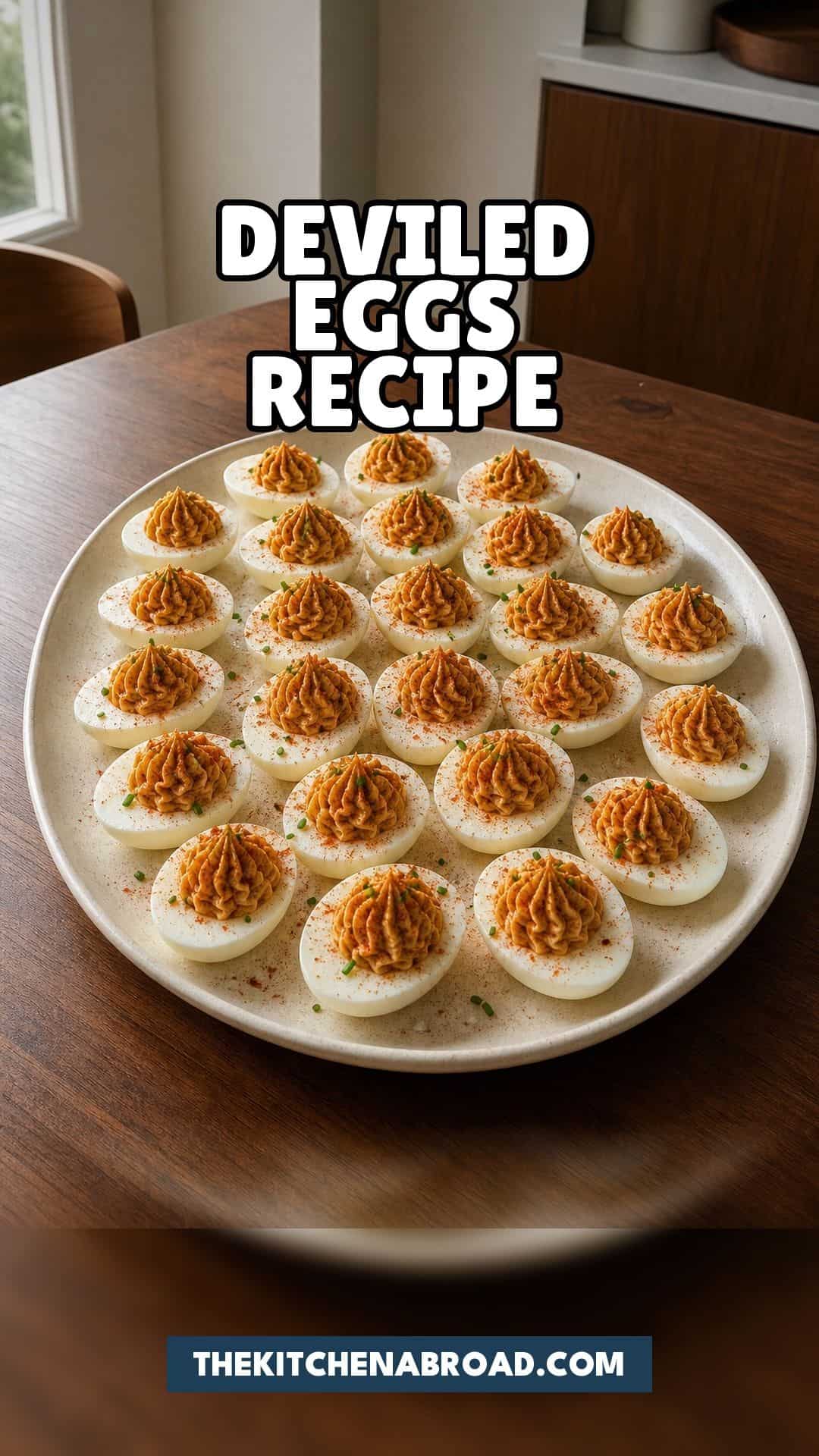
Deviled eggs with smoked paprika are a 12-egg, 24-half holiday appetizer built on Spanish pimentón de la Vera bloomed in mayonnaise, yolks passed through a fine sieve, and a small splash of sherry vinegar. Two halves per person, piped while the filling is cool (not cold), dusted with more pimentón and chopped chives. About 30 minutes of prep, with a make-ahead option that holds 24 hours in the fridge.
Deviled eggs are a 250-year-old English idea finished, in the version below, with the move that separates restaurant deviled eggs from home ones: pimentón bloomed in warm mayonnaise, and yolks passed through a fine sieve before the filling is mixed. The smoked paprika goes into the filling and dusted across the top, with a small splash of sherry vinegar tying the smoke to a tapas-bar frame. Two halves per person on a parsley-bedded tray, with cold cava poured before guests sit down.
Gear That Helps Here
The work is mostly knife and bowl. A fine-mesh sieve is the one piece of gear that actually changes the texture of the filling, and a piping bag fitted with a large star tip gets the ridge marks that hold the paprika dust. Everything else is standard.


Recommended Reads
- Best Christmas Finger Foods
- Christmas Snack Ideas
- Christmas Lunch Ideas
- Cranberry Brie Bites
- Cheese and Charcuterie Board
Where the Smoked Paprika Comes In
Deviled eggs trace back to ancient Rome (boiled eggs in spiced sauces appear in Apicius’s first-century cookbook), but the word “deviled” is 18th-century English shorthand for heavily seasoned, often peppered dishes. By the time the format crossed the Atlantic, it was an American picnic standard, the kind of dish that traveled in glass platters to church suppers and Fourth of July tables. The Spanish version, huevos rellenos con pimentón, is its tapas-bar cousin: same halved egg, same yolk-and-mayonnaise filling, with smoked paprika as the headline note instead of yellow mustard.
What pimentón de la Vera does that bright-red Hungarian sweet paprika cannot is bring an oak-smoked, air-dried backbone to the filling. The peppers are grown in Extremadura, smoked over oak fires for two weeks, then ground. Pimentón comes in three grades: dulce (sweet), agridulce (bittersweet), and picante (hot). Dulce is the right call for deviled eggs. The smoke does the work; you don’t need heat on top of it.
A Few Notes on the Ingredients
Buy the eggs ten days before you cook them. Older eggs peel cleaner than fresh ones because the inner membrane releases as the egg ages. Large eggs are the standard for this recipe; jumbo throws the filling-to-white ratio off. Look for shells without cracks, since cracked eggs will leak yolk into the cooking water and discolor the whites.
For the pimentón, Spanish brands labeled “pimentón de la Vera DOP” are the gold standard. Most major grocery stores stock it in the spice aisle near the paprika. If you can only find generic smoked paprika, it will still work, but the smoke note will be lighter. The sherry vinegar is the other small detail: a teaspoon of Spanish sherry vinegar (not lemon, not white wine vinegar) keeps the filling anchored to the same flavor family as the pimentón.
The mayonnaise should be full-fat. Light mayo breaks under the warm paprika and the filling weeps in the fridge. Dijon, not yellow, mustard gives the filling its sharp edge. A small spoonful of Greek yogurt or crème fraîche thins the texture without adding sweetness, which is what most homemade deviled egg fillings need.
Recipe: Deviled Eggs with Smoked Paprika
Prep time: 25 minutes | Cook time: 12 minutes | Total time: 37 minutes (plus 20 minutes cooling) | Serves: 12 (24 halves)
Ingredients
- 12 large eggs, ideally 10 days from purchase
- 120 g (½ cup) full-fat mayonnaise
- 15 g (1 tablespoon) Dijon mustard
- 15 ml (1 tablespoon) Greek yogurt or crème fraîche
- 5 ml (1 teaspoon) sherry vinegar
- 1½ teaspoons pimentón de la Vera dulce, divided
- ½ teaspoon fine sea salt
- ¼ teaspoon freshly cracked black pepper
- 2 tablespoons chopped fresh chives, plus more for finishing
- Flaky sea salt for finishing
Instructions
- Place 12 large eggs in a single layer in a wide saucepan and cover with cold water by 2.5 cm (1 inch). Bring to a hard rolling boil over high heat, then immediately remove the pan from the heat, cover with a tight lid, and let the eggs sit in the hot water for exactly 12 minutes.
- Drain the eggs and transfer them to a bowl of ice water. Let them sit for 10 minutes, then crack each shell all over against the counter and roll gently between your palms before peeling under cold running water. The shells should slip away in two or three pieces; if they fight you, the eggs were too fresh.
- Halve each peeled egg lengthwise with a sharp chef’s knife, wiping the blade between cuts to keep the whites clean. Pop the yolks into a small bowl and arrange the 24 whites on a parchment-lined sheet pan, cut side up.
- Press the yolks through a fine-mesh sieve into a medium bowl using the back of a spoon. The sieved yolks should look like dry, powdery crumbs; this is the single move that gives the filling its smooth, no-grit texture.
- In a small dry skillet over low heat, warm 120 g (½ cup) mayonnaise with 1 teaspoon pimentón de la Vera for about 90 seconds, stirring constantly, until the mayonnaise turns the color of brick and smells distinctly smoky. Do not let it bubble; you are blooming the paprika in fat, not cooking it.
- Scrape the warm bloomed mayonnaise into the sieved yolks. Add 15 g (1 tablespoon) Dijon mustard, 15 ml (1 tablespoon) Greek yogurt, 5 ml (1 teaspoon) sherry vinegar, ½ teaspoon fine sea salt, and ¼ teaspoon black pepper. Stir with a flexible spatula until the filling is smooth and the color is a uniform terra cotta.
- Fold in 2 tablespoons of chopped chives and taste for salt and acid. Adjust with a pinch more salt or a few drops more sherry vinegar if the filling reads flat.
- Spoon the filling into a piping bag fitted with a large star tip. Let the filling rest at room temperature for 10 minutes; cold filling tears the egg white edge and clogs the star tip, while filling that’s just below room temperature pipes in clean ridges.
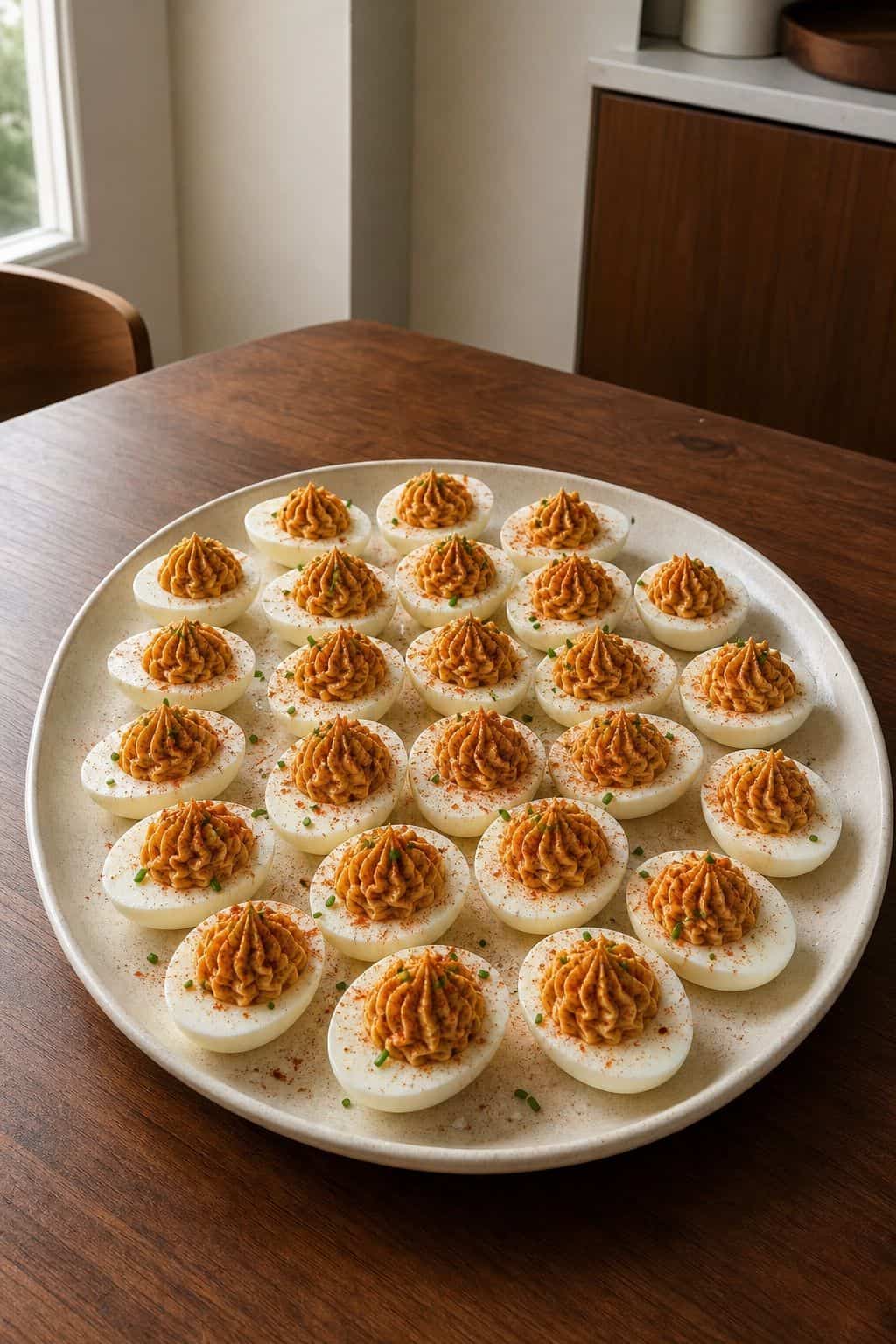
- Pipe a tall rosette into each egg white, finishing each one with a small upward pull to leave a peak. Refrigerate the platter, uncovered, for 15 minutes to let the rosettes set.
- Just before serving, dust the eggs with the remaining ½ teaspoon pimentón de la Vera through a small sieve so the powder lands evenly. Scatter the reserved chives across the platter and finish with a small pinch of flaky sea salt on each egg.
Notes
The 12-minute steep method (boil, cover, off-heat) produces the most consistent set yolks across a dozen eggs. Yolks that bounce after one minute past 12 are overcooked and will gray at the edges. If you prefer slightly softer yolks for piping, pull the eggs at 11 minutes; the texture will be richer but the filling will hold its shape less neatly.
For a make-ahead service, store the whites and the filling separately in the fridge for up to 24 hours: whites in a single layer on a parchment-lined plate, covered loosely, and the filling pressed against plastic wrap in a small bowl. Pipe within an hour of serving so the rosettes look freshly cut. Already-piped eggs can sit covered for up to four hours but lose some of their visual edge.
To transport the platter, set the assembled eggs on a parsley-bedded sheet pan or a deviled-egg-specific platter with wells; the parsley acts as a moat that stops the eggs from sliding when the platter tilts in the back of a car.
Tips and Variations
Bloom the paprika, do not just dust it
The single move that separates a deviled egg with smoked paprika from a deviled egg garnished with smoked paprika is blooming the pimentón in warm mayonnaise. Heat opens the volatile oils in the smoked peppers, the way you would bloom curry paste in oil at the start of a Thai curry. Cold paprika stirred into cold mayonnaise tastes dusty; bloomed paprika tastes like a tapas bar.
Sieve the yolks, every time
Fork-mashed yolks always carry small lumps that look fine in the bowl and read as grit on the tongue. Pressing the yolks through a fine-mesh sieve takes 90 seconds and gives the filling the texture of restaurant pâté. If you do nothing else from this recipe, do this.
Pipe at cool, not cold
Filling pulled straight from the fridge clogs a star tip and tears the rim of each egg white as you pipe. Let the bag sit on the counter for 10 minutes after refrigeration. The filling should feel cool but pliable when you squeeze the bag, not stiff.
Swap chives for crispy serrano
For a richer tapas-bar version, crisp 4 thin slices of serrano ham in a dry pan for 90 seconds per side, drain on paper towels, and crumble across the platter just before serving instead of chives. The cured meat doubles down on the Spanish frame and gives the platter a textural counterpoint.
Storage and reheating
Deviled eggs keep for 48 hours in the fridge, covered, on a parchment-lined plate. Beyond that, the whites turn rubbery and the filling weeps. They do not freeze; the whites collapse when thawed. Bring them out 15 minutes before serving so the chill comes off.
What to Pour Alongside
The smoked paprika asks for a drink with enough acid to cut through the mayonnaise. A cold cava is the answer most Spanish bars would give: the dryness scrapes the fat off the tongue and the bubbles refresh the palate between bites. A classic French 75 works for the same reason, with lemon doing the heavy lifting that the cava handles with bubbles. For a no-cocktail option, a chilled fino sherry or a dry Albariño matches the Spanish frame.
On the food side, deviled eggs sit alongside a cheese and charcuterie board with a slice of jamón, a wedge of manchego, and a small bowl of Castelvetrano olives. The platter logic is straightforward: two-three appetizers, a board, and one cocktail per guest. For a Friendsgiving spread or a Christmas Eve cocktail hour, plan two halves per person.
Frequently Asked Questions
Why use smoked paprika instead of regular paprika in deviled eggs?
Smoked paprika, specifically Spanish pimentón de la Vera, is oak-smoked and air-dried, which gives the eggs a campfire backbone that Hungarian sweet paprika cannot match. Regular paprika brings color and a mild peppery note. Pimentón brings smoke, sweetness, and a slight earthiness that pairs with the yolk’s richness.
Can deviled eggs be made the day before?
Yes, with a caveat. Store the cooked egg whites and the filling separately in the fridge for up to 24 hours. Pipe the filling into the whites within an hour of serving so the rosettes look freshly cut. Already-piped eggs hold for about four hours but lose visual sharpness over time.
How do you keep deviled eggs from sliding on the platter?
The simplest fix is a deviled-egg-specific platter with shallow wells that cradle each half. The next-best fix is a bed of fresh parsley spread across a sheet pan or platter; the parsley acts as a moat that locks the eggs in place. A dollop of filling underneath each egg-white half also glues it to the platter.
What’s the trick to peeling hard-boiled eggs cleanly?
Use eggs that are about 10 days from purchase, since older eggs peel cleaner than fresh ones. The second move is shocking the eggs in ice water for 10 minutes after cooking, then cracking the shells all over against the counter before peeling under cold running water. The shells should slip away in two or three pieces.
What’s the difference between Spanish smoked paprika and Hungarian paprika?
Spanish pimentón is smoked over oak fires for two weeks before grinding, which gives it a smoky, deeper note. Hungarian paprika is dried (sometimes sun-dried, sometimes mechanically) without smoke and is generally brighter, sweeter, and redder. For deviled eggs, Spanish pimentón is the right call because the smoke pairs with the yolk.
Key Takeaways
- Buy eggs 10 days before cooking; older eggs peel cleaner than fresh.
- Boil 12 eggs, cover, off-heat, and steep for exactly 12 minutes for evenly set yolks.
- Press the yolks through a fine-mesh sieve before mixing the filling; this is the single biggest texture upgrade.
- Bloom pimentón de la Vera in warm mayonnaise for 90 seconds before stirring it into the yolks; cold paprika tastes dusty.
- Pipe the filling cool, not cold, so the bag flows cleanly through a large star tip.
- Plan two halves per guest and pair with a cold cava or a French 75.
Final Thoughts
Deviled eggs are a dish that punishes shortcuts. Skip the sieve and the filling will read as gritty. Skip the bloom and the paprika will sit on top of the eggs like dust on a windowsill instead of folding into the filling. Skip the 10-minute counter rest before piping and the rosettes will tear at the edge of every egg white. None of these moves take more than a few minutes, and together they turn a picnic standard into a tapas-bar pintxo.
Serve them on a parsley-bedded tray with two cocktails ready (cava on ice for the guests who arrive early, a stronger French 75 for the ones who arrive late), and plan two halves per person. If guests linger over the platter, you’ll know the smoked paprika did its job.
Deviled Eggs with Smoked Paprika
Deviled eggs with smoked paprika are a 12-egg, 24-half holiday appetizer built on Spanish pimentón de la Vera bloomed in mayonnaise, yolks passed through a fine sieve, and a small splash of sherry vinegar.
Ingredients
- 12 large eggs, ideally 10 days from purchase
- 120 g (½ cup) full-fat mayonnaise
- 15 g (1 tablespoon) Dijon mustard
- 15 ml (1 tablespoon) Greek yogurt or crème fraîche
- 5 ml (1 teaspoon) sherry vinegar
- 1½ teaspoons pimentón de la Vera dulce, divided
- ½ teaspoon fine sea salt
- ¼ teaspoon freshly cracked black pepper
- 2 tablespoons chopped fresh chives, plus more for finishing
- Flaky sea salt for finishing
Instructions
- Place 12 large eggs in a single layer in a wide saucepan and cover with cold water by 2.5 cm (1 inch).
- Drain the eggs and transfer them to a bowl of ice water. Let them sit for 10 minutes, then crack each shell all over against the counter and roll gently between your palms before peeling under cold running water.
- Halve each peeled egg lengthwise with a sharp chef's knife, wiping the blade between cuts to keep the whites clean. Pop the yolks into a small bowl and arrange the 24 whites on a parchment-lined sheet pan, cut side up.
- Press the yolks through a fine-mesh sieve into a medium bowl using the back of a spoon. The sieved yolks should look like dry, powdery crumbs; this is the single move that gives the filling its smooth, no-grit texture.
- In a small dry skillet over low heat, warm 120 g (½ cup) mayonnaise with 1 teaspoon pimentón de la Vera for about 90 seconds, stirring constantly, until the mayonnaise turns the color of brick and smells distinctly smoky.
- Scrape the warm bloomed mayonnaise into the sieved yolks. Add 15 g (1 tablespoon) Dijon mustard, 15 ml (1 tablespoon) Greek yogurt, 5 ml (1 teaspoon) sherry vinegar, ½ teaspoon fine sea salt, and ¼ teaspoon black pepper.
- Fold in 2 tablespoons of chopped chives and taste for salt and acid. Adjust with a pinch more salt or a few drops more sherry vinegar if the filling reads flat.
- Spoon the filling into a piping bag fitted with a large star tip. Let the filling rest at room temperature for 10 minutes; cold filling tears the egg white edge and clogs the star tip, while filling that's just below room temperature pipes in clean ridges.
- Pipe a tall rosette into each egg white, finishing each one with a small upward pull to leave a peak. Refrigerate the platter, uncovered, for 15 minutes to let the rosettes set.
- Just before serving, dust the eggs with the remaining ½ teaspoon pimentón de la Vera through a small sieve so the powder lands evenly. Scatter the reserved chives across the platter and finish with a small pinch of flaky sea salt on each egg.
Notes
The 12-minute steep method (boil, cover, off-heat) produces the most consistent set yolks across a dozen eggs. Yolks that bounce after one minute past 12 are overcooked and will gray at the edges. If you prefer slightly softer yolks for piping, pull the eggs at 11 minutes; the texture will be richer but the filling will hold its shape less neatly.
For a make-ahead service, store the whites and the filling separately in the fridge for up to 24 hours: whites in a single layer on a parchment-lined plate, covered loosely, and the filling pressed against plastic wrap in a small bowl. Pipe within an hour of serving so the rosettes look freshly cut. Already-piped eggs can sit covered for up to four hours but lose some of their visual edge.
Last update on 2026-08-10 / Affiliate links / Images from Amazon Product Advertising API